Renaissance Standing Salt Physical Object
Accession Number
1989.002.0004cCreation Date
circa 1600Description
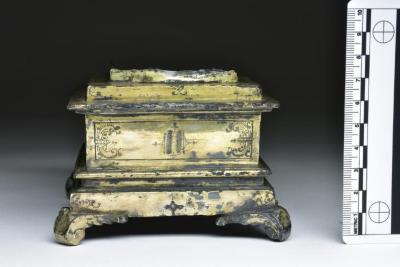
Base section of three tiered salt. See also 1989.002.0004a, b. Herrera style, large stepped and graduated- upright rectangular form and in three sections, the upper section of domical form and surmounted by a pierced finial over a pierced cover chased with stylized scrollwork over a stepped- rectangular base, the mid-section similarly-stepped and decorated with conforming near-square panels centered by stylized lozenges on each side, the lower section comprised of a large stepped-rectangular base elaborately decorated with multiple C-scrolls and raised double-oval bosses, raised on four molded and spurred down-scrolling feet. 25.0 cm by 11.5 cm square (at base) and 6.3 cm (square) at top.Dimensions
10.6 x 10.6 x 7.6 cm
Exhibition Label
Object Caption (2023):Salt Cellars
Silver gilt and silver, (possibly Peru, c.1600)
Gifts of Dr. Edwin Davis, Jamestown Inc., T.S.I Liquidation Trust
1986.008.0610a, 1989.002.0004a, 1999.007.0003a
Salt was a precious commodity during the 1600s and the lavish display of salt implied the wealth of the owner.
Of these salt cellars, the largest would have been known as a “great salt.” It would have been placed on the high table, next to the host, who would share the condiment with his most important guests. Great salts were often exchanged as New Year's gifts among the nobility and passed on as heirlooms. Although salts frequently appear in household inventories of the period, few physical examples survive today.
Simpler in design, the smaller salts would have been objects of prestige and value in the home of a well-to-do colonist. Originally, they would have been gilded and decorated with colorful enamels.